What we do to Iranian asylum seekers
Indefinite incarceration of people without a criminal charge is one of the world's most severe breaches of International Human Rights conventions.
Yet this is what Australia does with the asylum seekers who, under the "stitched-up Migration Act", have been excluded from Australia as refugees.
This page highlights the situation of some of the Iranian asylum seekers, who are held indefinitely in the detention centres around Australia.
The desperation of asylum seekers is dramatically exemplified by the self-harm incidents we have witnessed in Australia's detention centres in recent years. We have had hunger strikes, people resorting to lip-stitching, and people 'slashing up', as it is called. Now, in the first half of 2003, hundreds of Iranians face forced deportation after "secret deportation deals" have been made by the Australian Minister for Immigration Philip Ruddock with the Iranian government.
1 August 2003: The plight of the Mandaeans: A new Iran contra deal - "The Government wants to test the resistance of Australians to this indecency. I hope they are unpleasantly surprised and that Australians will draw the line at forcing people back to situations where their very lives are at risk." In this piece, which appeared first in Margo Kingston's Web Diary, Carmen Lawrence discusses the Mandaean issue.
30 January 2003: Open Letter to Politicians Full Of Questions About Refugees - We're asking a barrage of questions about visiting Iranian Mullahs to Canberra, the secret plans to deport 190 Iranians from Australia, and on this page we're including questions about Minister Ruddock being scared for the UN Committee Against Torture or the UN Human Rights Committee.
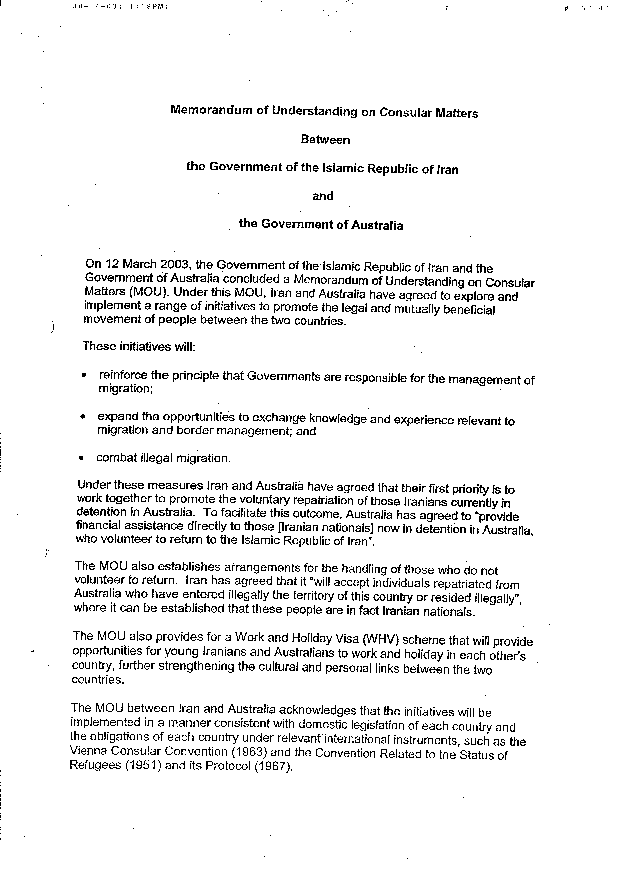
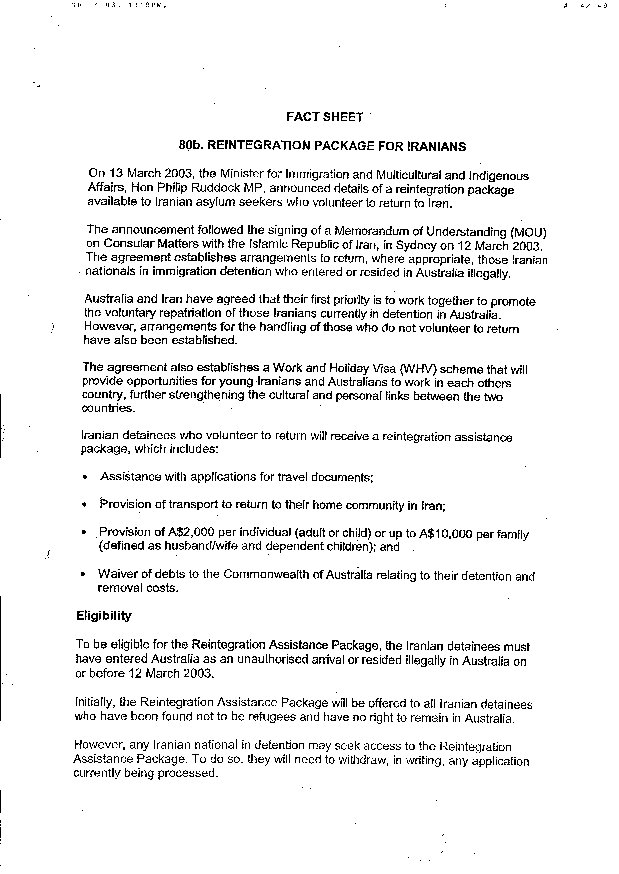
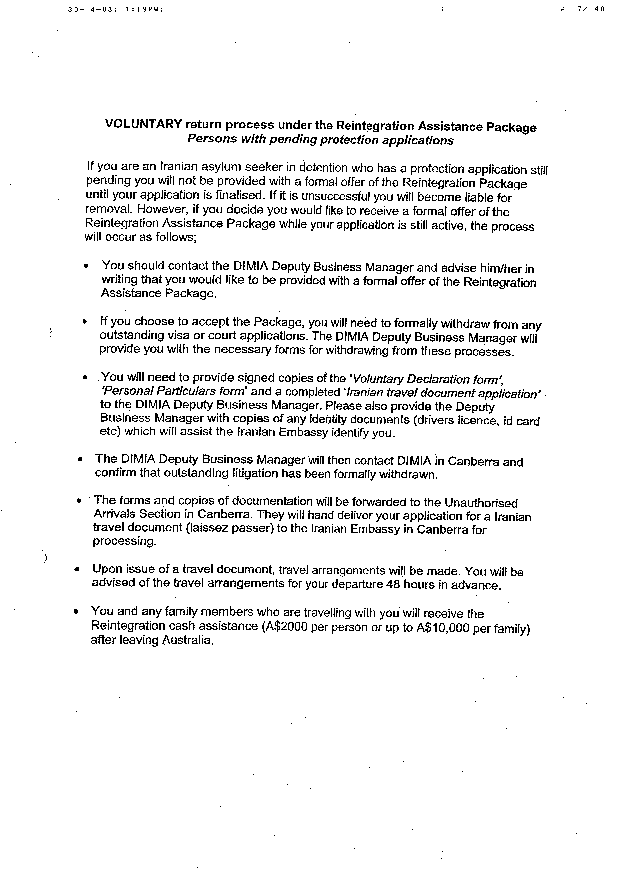
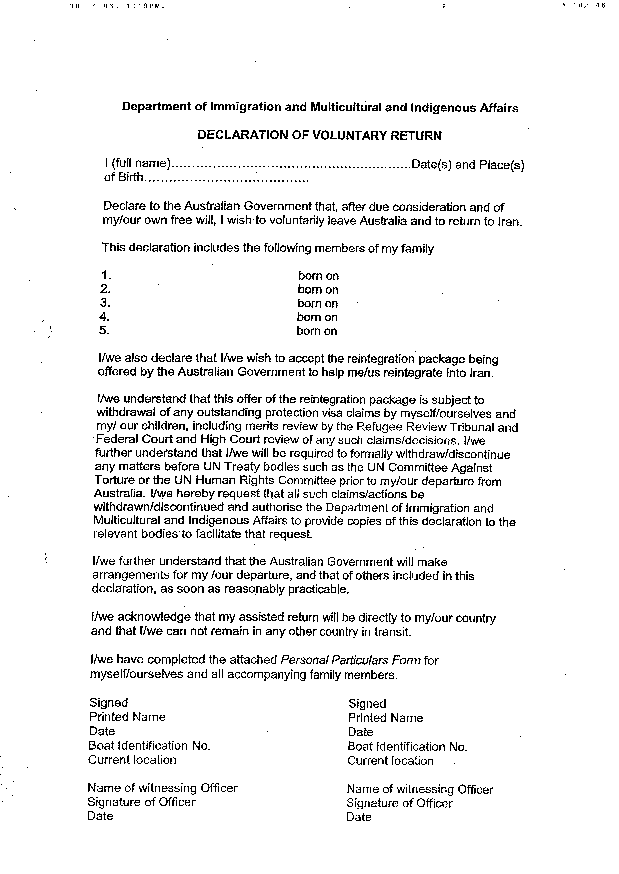
Below are links to nine out of eleven pages from the DIMIA Information Sheet for Iranian Detainees, handed to detainees in Australian detention centres in April/May 2003.
| DIMIA Information Sheet for Iranian Detainees | |
| page one | not available |
| page two | click here to open |
| page three | click here to open |
| page four | click here to open |
| page five | click here to open |
| page six | click here to open |
| page seven | click here to open |
| page eight | click here to open |
| page nine | not available |
| page ten | click here to open |
| page eleven | click here to open |

Baxter IRPC
Baxter, Port Augusta SA
Friday 22 August 2003
Dear Prime Minister and all Australian People,
This letter is from all us poor Iranians here at Baxter, which is our prison. I have told this letter to my friend on the telephone because now we have no time. It is Friday night and we are all very frightened because they tell us that tomorrow we will be deported by force to our country.
So tonight we cannot sleep. We pray that something will save us and we try to help each other. We are real human beings and fathers and sons and husbands. We did not leave our country and our family for getting rich or big adventure. We must leave because our government is a dictatorship that tortures and kills its own people like it was in Iraq and we see on television how they open the graves of the poor tortured people. All the governments and the United Nations know that the Iranian government has no respect for human rights.
We ask for help from the government in Australia. We ask that you see that we cannot go back to Iran because we are too afraid of the torture and prison we will have to go to. Many of us have already lost family or have brothers and fathers in prison in Iran. Because we have not always explained our situation in the best way for DIMIA officers to understand, they say that we have failed and are not real refugees and the court cannot help us.
In our country, we tried to have democracy and freedom but we have been put in prison for it. Then we came here because Australia is a democratic country, but they put us in prison, too. How can we show you that we are not bad people?
Sometimes, some of us have been too stressed and sometimes we broke something in detention. We are sorry for that. We are not violent people; only sometimes we cannot endure this prison hell here any more.
Now nobody is coming to Australia anymore and your government has fulfilled its wish. But we have suffered for almost 3 years for this policy and we have suffered enough. If it would be possible for us to go home, we would have gone a long time ago even before your government offered us money to go away. But we cannot. If you will not let us stay here, please send us to some other country. A poor country or any country. We will go anywhere but we cannot go back to Iran.
We need your help in this terrible situation. Please help us and stop this deportation of us. We beg you from our heart. Signed by some of the Iranians.
Some Iranian residents
in the Baxter detention centre
Port Hedland IRPC
PO Box 377
Port Hedland WA 6721
Tel (08) 9173-2822
Fax (08) 9173-2825
We, Iranian asylum seekers in the Port Hedland detention centre, give our permission to publish the below letter in any newspaper on the understanding that all identifying details will be changed or omitted.
Yours Truly,
[signed]

We, Iranian asylum seekers in the Port Hedland detention centre, considering that it is about three years that we have been locked up in the Australian detention centres and have no hope for any positive changes in the refugee policy of Australia and we can no longer bear these circumstances, request the United Nations High Commissioner for Refugees (UNHCR) and also the government and community of Australia for settlement and being processed in a country other than Australia.
Iranian asylum seekers
01 March 2003
[this document carries 64 signatures]
To the Rev. Prof. James Haire
President of the Uniting Church in Australia
Dear Hon James Haire
We, Iranian asylum seekers who have been locked up in the immigration detention centres, can not to convince the federal government of Australia to change its refugee policy at all. And also we don't insist to remain in Australia.
In regard to the recent discussion between the Australian and the Iranian government about deporting us to Iran (which was unsuccessful), we are willing to be sent to other countries of refugee convention.
We emphasise strongly that we are just looking for a safe and peaceful place to live, no matter where it is.
We request you kindly to take this matter to the related authorities consideration. Your consideration about above matter is appreciated.
Christian Iranian residents
in the Port Hedland detention centre

This drawing was made by a sixteen year old Iranian boy who has now been held in detention for over three years. Whilst in detention he experienced much pain, made many attempts on his life, was locked in the solitary confinement block in Port Hedland for 15 days (Juliet Block) and was separated from his parents for months.
"Cell" represents the 15 days that the sixteen year old Iranian boy spent in solitary confinement in Juliet block after the riots at Port Hedland. He said that the room was very dirty and that the door was only opened for 10 minutes each day. He said that he was given a plastic bag to excrete in. The only thing in the room was a low bed. The boy kept a tally on the wall just like the person in the drawing.
He is a member of a family from Iraq. The father's brother and his sons were executed by Saddam Hussein's forces as Shia Muslims suspected of belonging to the oppositionist Al Da'wa Party.
The father feared he would be next and fled with his family to Jordan. They weren't permitted to settle there, or in Syria, where they went after Jordan, and finally bought passage on a boat from Indonesia, arriving in Australia in December 1999. They have been in three detention centres in which their experiences were horrific, and the four children are deeply traumatised by them.
The oldest of the children, now 18, and the artist, 16, are reported to have been abused, beaten and manacled by the guards, and the other two, aged 12 and 6, are both suffering from nightmares and panic attacks after witnessing suicides, detainees slashing themselves with razors, hunger strikes and beatings, as well as from anxiety due to forced separations from their mother and their father. (The father was separated from his family for nearly 12 months).
The 16-year-old artist and the 18-year-old have both attempted suicide and carried out acts of self-harm, including striking the razor wire and sewing their lips together. Yet as the artist told a psychologist: "I'm not crazy. I just want my freedom." They were locked up for 36 months of their young lives, denied a proper education (the artist wanted nothing more than to go to high school but there's no schooling for over-12s) and treated like criminals during their time in this country.
A young Iranian man of a peaceful disposition, never a trouble maker, said of his impending deportation to Iran and after years in detention in Australia: "I can't take this anymore. At least for the 10 hours on the plane I will have freedom, before they kill me".
This man has converted to Christianity, and that is a capital offence in Iran. He won't be able to contact his family, because it would put them in danger. How alone can a human be.
Will the Australian Government track what happend to the men, women and children being forced to go back to Iran, from which they fled in fear? What has changed in this time, to make it safe for them?
Frances Milne
Convenor
Interfaith Coalition for the
Protection of Asylum Seekers
Wednesday, March 12, 2003 12:17 PM
Steve Ingram, Media Adviser to Minister Ruddock, has confirmed that there will be an announcement in the next couple of days, that agreement has been reached with the Iranian Government to accept back the 190 Iranians who will then be forcibly deported from Australia's detention centres. Reports have also just been received that the Minister has cancelled High Court hearings for two Iranians from Baxter and Port Hedland while "other decisions are being made".
To date Iran has refused to accept back Iranians who resist deportation by refusing to sign travel documents which would enable the Government to forcibly deport them. These Iranian detainees share a bleak fate with other long-term detainees from such brutal regimes as Iraq, Sudan, Sierra Leone, Colombia, and yet our Government refuses to give them protection visas.
It is likely that the Minister's announcement on forced deportation to Iran will be timed to coincide with, and be swamped in the media by the PM's speech about Australia's role in a war with Iraq at the Press Club luncheon on Thursday 13 March.
The irony is that the PM will no doubt represent the war as a war of liberation for the Iraqi people. But with Iraqis among the long-term detainees rotting in Australia's detention centres, the international community might well challenge the bona fides and double standards of a Prime Minister who incarcerates men, women and children who refuse to return to regimes like that of Saddam Hussein to face death, torture, imprisonment and widespread human rights abuses.
While the dreadful human rights abuses of the Iraqi Government will continue to be headline news, Iran needs similar exposure. Please see below excerpts from the US State Department's Country Report on Human Rights Practices (2001): Iran, which provides the gruesome details of this savage regime.
The Coalition seeks your support for an Act of Grace from both houses allowing the release of those detainees who have a genuine need for protection either under the Refugee Convention and Protocol or for other reasons. While we need to be clear that the long term detainees are in genuine need of protection from countries which cannot offer effective protection such as Iran and Iraq, the High Court in early February demanded that from now on the Department of Immigration and the Refugee Review Tribunal apply the general rules of law in deciding whether or not a person is a refugee. No longer is it good enough for a single Tribunal Member to claim bone fides in the way they make decisions, they must now apply proper legal process. This raises the issue of how many of those in long-term detention including Iraqis and Iranians would have been given protection if these legal requirements had been in place when their cases were being decided.
The Coalition also seeks your support for an Act of Grace from both houses for those refugees on Temporary Protection Visas to be given Permanent Protection Visas.
"The Government significantly restricts citizen's rights to change their government. Systematic abuses include summary executions, disappearances, widespread use of torture and other degrading treatment reportedly including rape, severe punishments such as stoning and flogging, harsh prison conditions, arbitrary arrest and detention, and prolonged and incommunicado detention.
The Government uses the judiciary to stifle dissent and obstruct progress on human rights. The Government infringes on citizen's privacy rights, and restricts freedom of speech, press, assembly and association. Over the last two years, the Government has closed nearly all reform oriented publications, and brought charges against prominent political figures and members of the clergy for expressing ideas viewed as contrary to the ruling orthodoxy".
120,000 executions on political grounds; victims include pregnant women, elderly women and schoolchildren;
30,000 political prisoners massacred in 1988;
Over 170 forms of physical and psychological torture;
800,000 persons admitted to jails every year;
Stoning, hanging in public, eye gouging, amputation of fingers, hands and legs, beheading, and flogging in public carried out as "punishment";
Discrimination against women in law and practice;
Suppression of religious and ethnic minorities;
450 terrorist operations around the world, including bombings, hijacking, abductions and assassinations;
140 terrorist attacks against the Iranian Mojahedin in Iraq since 1993;
474 public executions have been announced in 2002; a 50% rise compared with the previous year;
80 newspapers and periodicals have been closed down by the regime since April 2000. Dozens of journalists remain in jail. Rapporteurs Sans Frontieres called Iran "the biggest prison for journalists";
Under mullahs' regime, Iran has highest suicide rate in the world (200 fatal suicide attempts for every 100,000 heads of population);
1,500 Iranians leave the country every day, fleeing the mullahs' repression.
In his report to the United Nations Human Rights Commission in March 2002, the Commission's Special Representative for Iran, Professor Maurice Copithorne:
expressed concern at the "apparent rise in flogging and execution, over the public application of such punishments and over their apparent application in some cases to minors" and the "recent cases of stoning to death."
described the massacre of political prisoners in Iran in 1988 as one of "the blackest events in the history of the Islamic Republic."
noted that the widespread feeling of "frustration" and "disillusionment" among the people in the country "certainly seems to have been reflected in the disturbances in August in Sabzevar and in October in Tehran."
emphasized that "accepted norms of fair trial are frequently ignored. Many of the punishments are gross violations of international human rights norms, including in particular the use of stoning."
noted that "the treatment of intellectuals and dissidents, particularly by the security forces and the Judiciary, reveals a fearful intolerance of alternative views."
referred to the "serial murders" carried out by the mullahs' Intelligence Ministry, pointing to "the apparently widespread view that the trial was a cover-up and that the real motives behind the killings, as well as the likely knowledge of them of senior figures, had yet to be revealed." He also stated that Khatami's "Minister of Information (Intelligence) was quoted in the press as characterizing these murders as 'insignificant mistakes,' adding that the people have forgiven 'those concerned.' In the view of the Special Representative, taking anyone's life, not least when the act is politically motivated, can never be characterized as insignificant. The Minister's comments are surely an insult to the memory of the victims and to their family members. They also reflect an appalling disrespect for the most basic of human rights, the right to life, and by a member of the Government at that."
expressed concern at "the suppression of various types of expression continued in the period under review," pointing out that "more newspapers and journals were banned or temporarily suspended" and more arrests were made.
noted that "the prison population has increased over 40 per cent in the previous year, and the prisons were now housing more than 100,000 inmates beyond their capacity."
stated that "over the years, the Special Representative has frequently expressed his concern over the status of women in Iran" and that "there can be no doubt that the treatment of minorities in Iran does not meet the norms set out in the Declaration on Minorities or in article 27 of the International Covenant on Civil and Political Rights."
Source: http://www.iranncrfac.org/